I built the first version of iFire to solve a problem on my own station: knowing who was available without phoning round. Twenty years in, I'm still a retained firefighter, and I still use it on every call. Since then it has grown into iFire, iCrew and iRescue, used by fire, rescue and lifeboat crews. For all that time it has been free, with an optional subscription for anyone who wanted the extras.
That is changing. iOnCall is moving to a station subscription: one simple licence for the whole crew, with every feature included. I want to explain why, what you get and what it costs. I also want to be completely clear about the one thing that isn't changing.
The short version
- One subscription per station. It covers every crew member and every feature, in the app and in the new Station Dashboard.
- £1 per active crew member a month (minimum £10), or £10 per active crew member a year (minimum £100), which is two months free.
- You only pay for people who use it. Dormant members and leavers are free.
- New stations will get a 30-day free trial, with no card needed, when the Station Dashboard opens to them shortly.
- Existing stations have until 31 January 2027 before anything changes.
- Callouts are never locked. Even if a subscription lapses, mobilisation alerts, responding and status updates keep working.
Why we're changing
The free model has done one thing well: it has paid its way. Hosting, notifications, email, security and the app store accounts are covered by the subscriptions people chose to take out. I'm genuinely grateful to every one of you who did.
What it has never paid for is the time it takes to develop and look after the system. A lot of that time goes on support: setting stations up, answering questions and fixing problems. The honest truth is that most of it goes to stations where nobody subscribes. I'm glad to help. But every hour spent that way is an hour not spent improving the product, and that isn't a sustainable way to run something crews rely on when the pager goes off.
Voluntary subscriptions also put the cost on a handful of individuals while the whole station benefited. A station subscription is fairer. The station that uses the system pays for it, at a price that grows and shrinks with the size of the crew.
It has grown into a system
This isn't the app it was a few years ago. It has been rebuilt from the ground up, and in that time we've added:
- mobilisation alerts that sound through silent mode and Do Not Disturb, like a pager
- geofencing prompts that offer to update your availability as you arrive and leave
- contracted-hours tracking, weekly summary emails and historical statistics
- line managers, appliances and live responding status
- UK hosting, a full security review and the groundwork to become a UK Government G-Cloud supplier
Then there's the biggest addition yet. Put together, it's a system you'd expect to license, and that's what we're doing.
Introducing the Station Dashboard
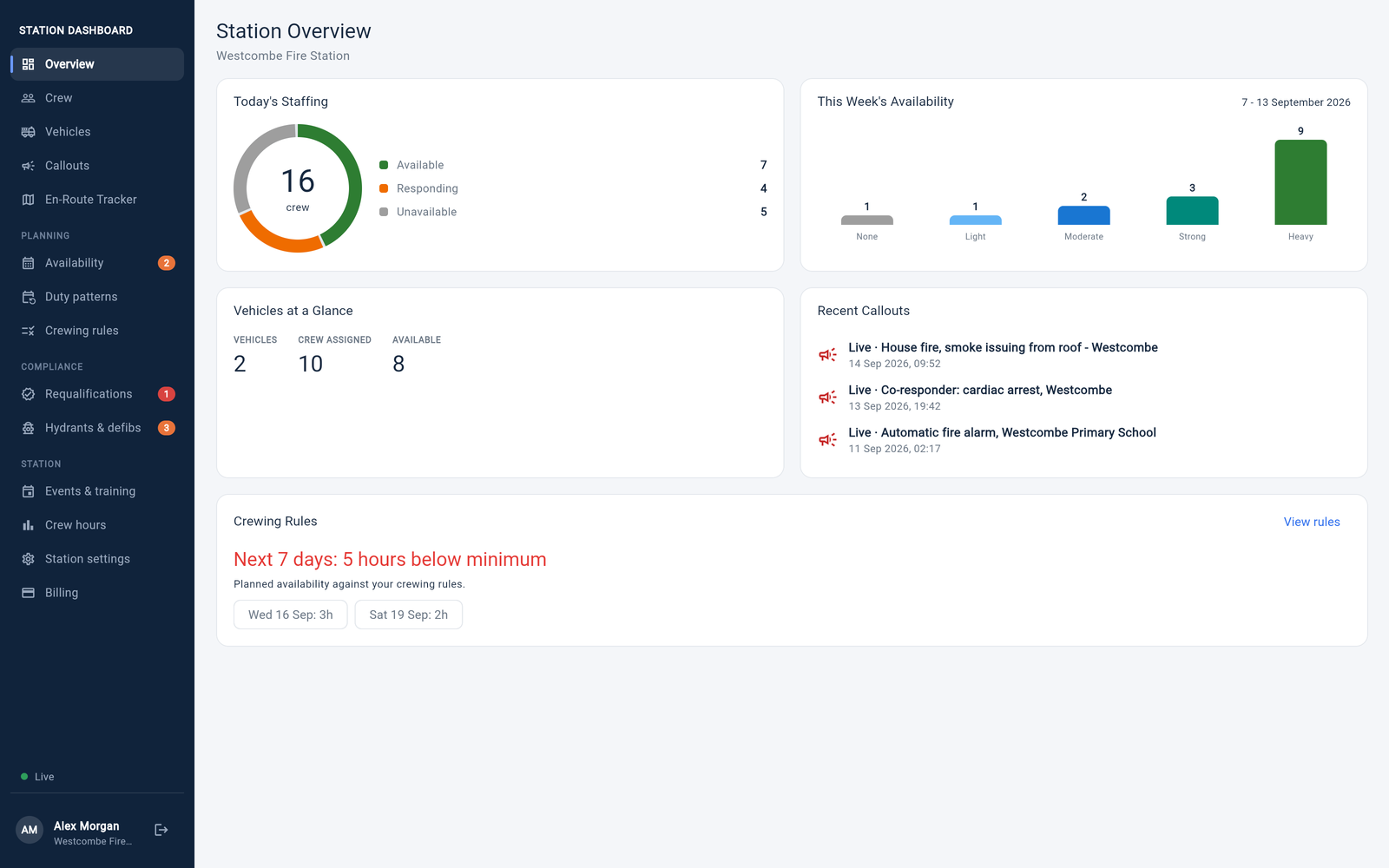
The Station Dashboard is a full web application for running your station. It works in any browser on any computer, and it's built for the jobs that are painful on a phone: planning, compliance and managing a crew. It updates live, so what you're looking at is what's happening now. I'm finishing testing it now, and it opens to every station shortly.
Plan availability weeks ahead
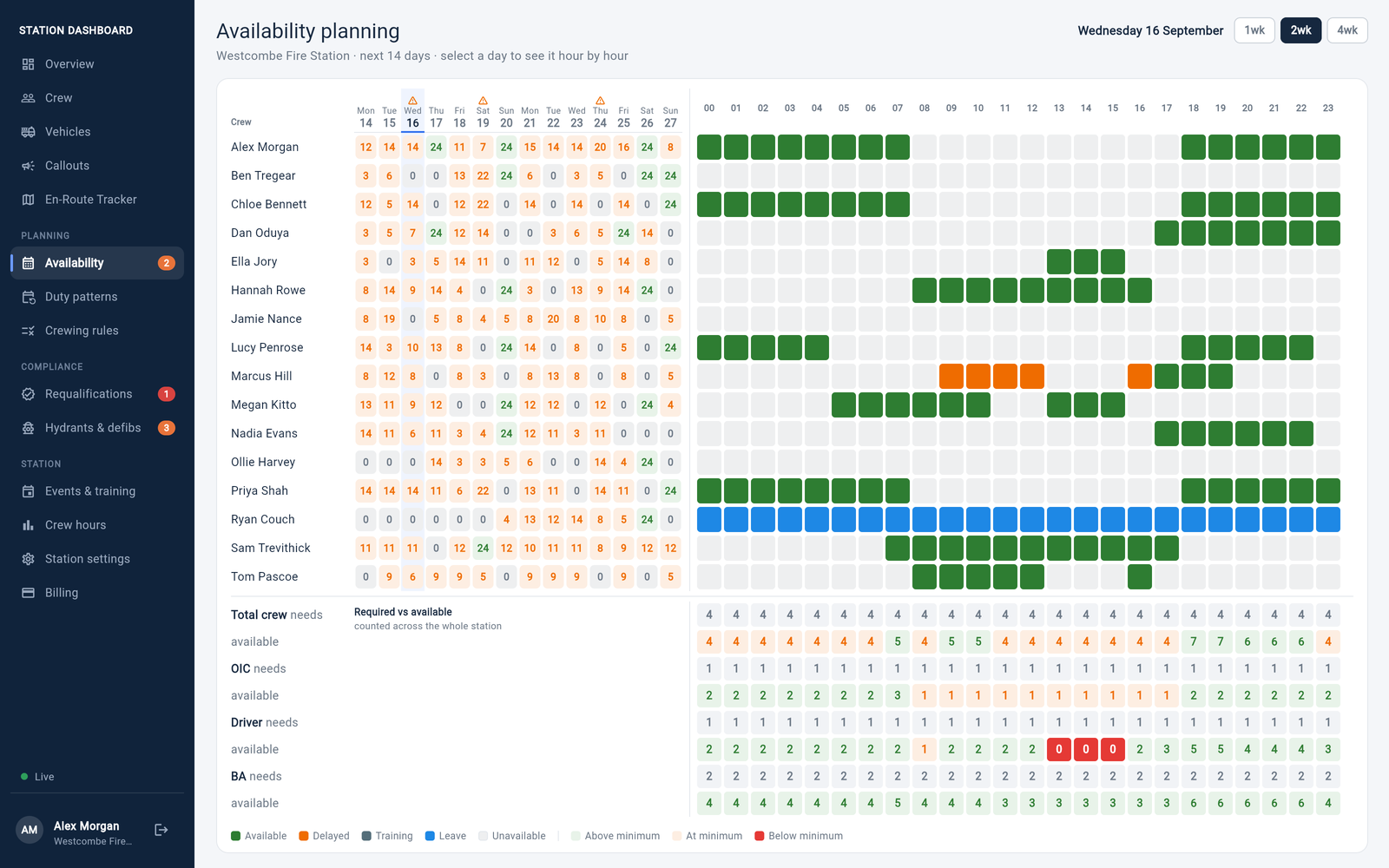
The availability planner shows every crew member's availability, hour by hour, for the weeks ahead. It highlights exactly where you'll drop below safe crewing, so you can fix a gap on Tuesday before Tuesday arrives. Line managers can update availability for the crew they manage, and duty patterns apply a regular rota in a couple of clicks.
Crewing rules and compliance
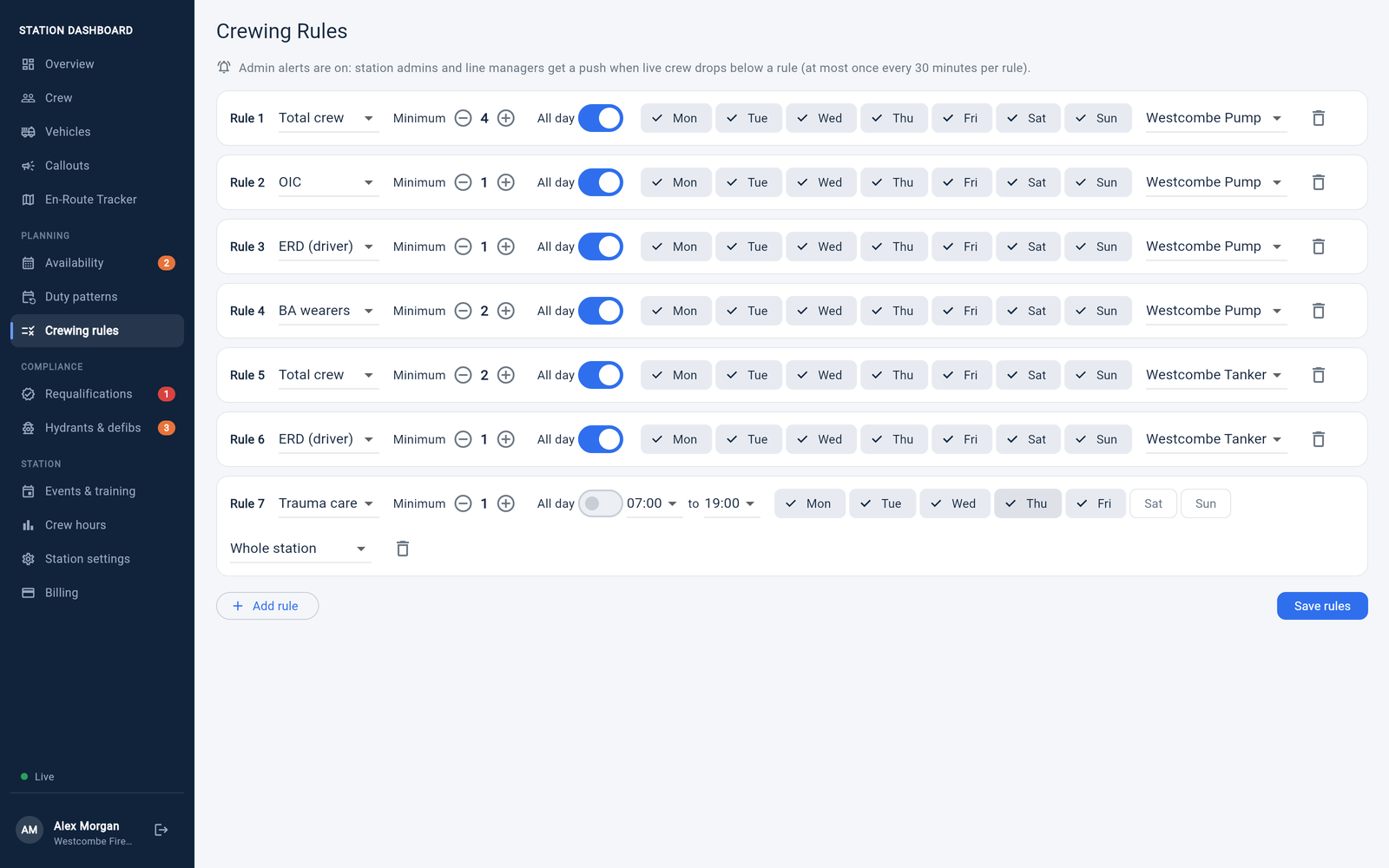
Tell the dashboard what each appliance needs to go out: for example four crew, including an officer in charge, a driver and two breathing apparatus wearers. Rules can apply all day or only at certain times. The availability planner then flags every hour where you won't meet them, and station admins and line managers get a push notification if live crewing drops below a rule.
Requalifications that don't creep up on you
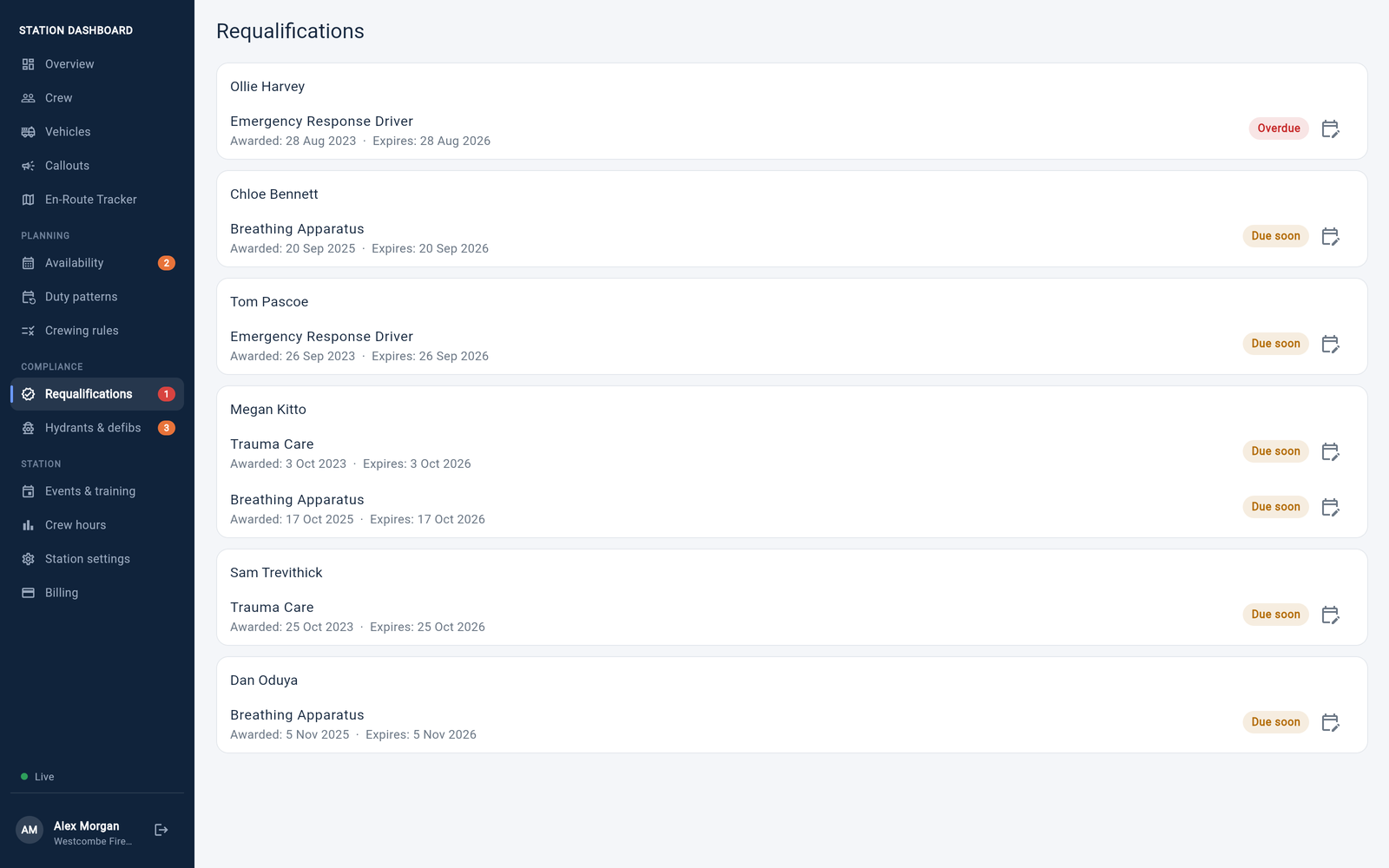
Record when each qualification is due for renewal and see what's coming up and what's overdue, for every member of the crew, on one page.
Callouts and the en-route tracker
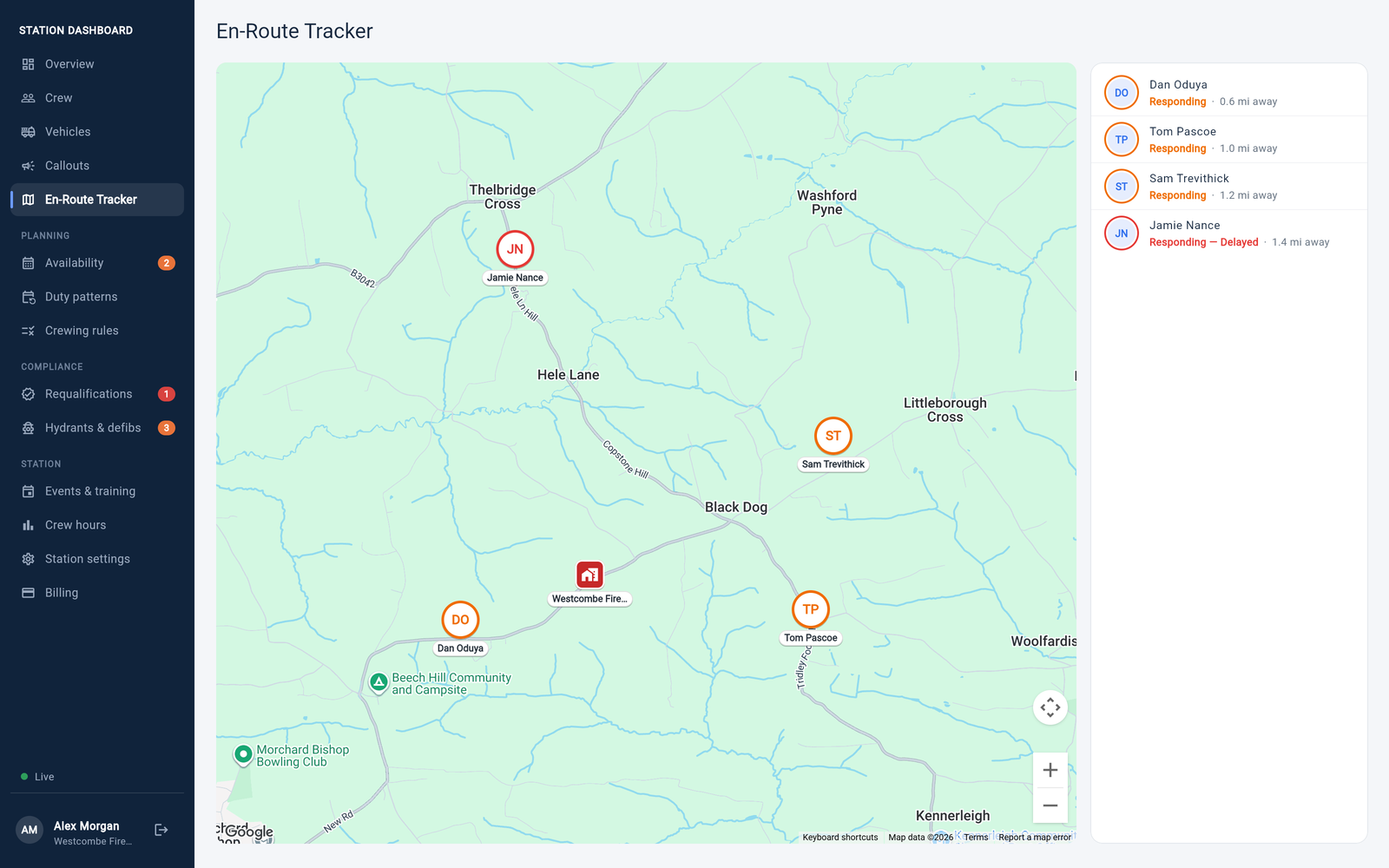
Send a test or live callout from the dashboard, then watch who's responding on a live map, and see how far each responder is from the station.
Your crew, all in one place
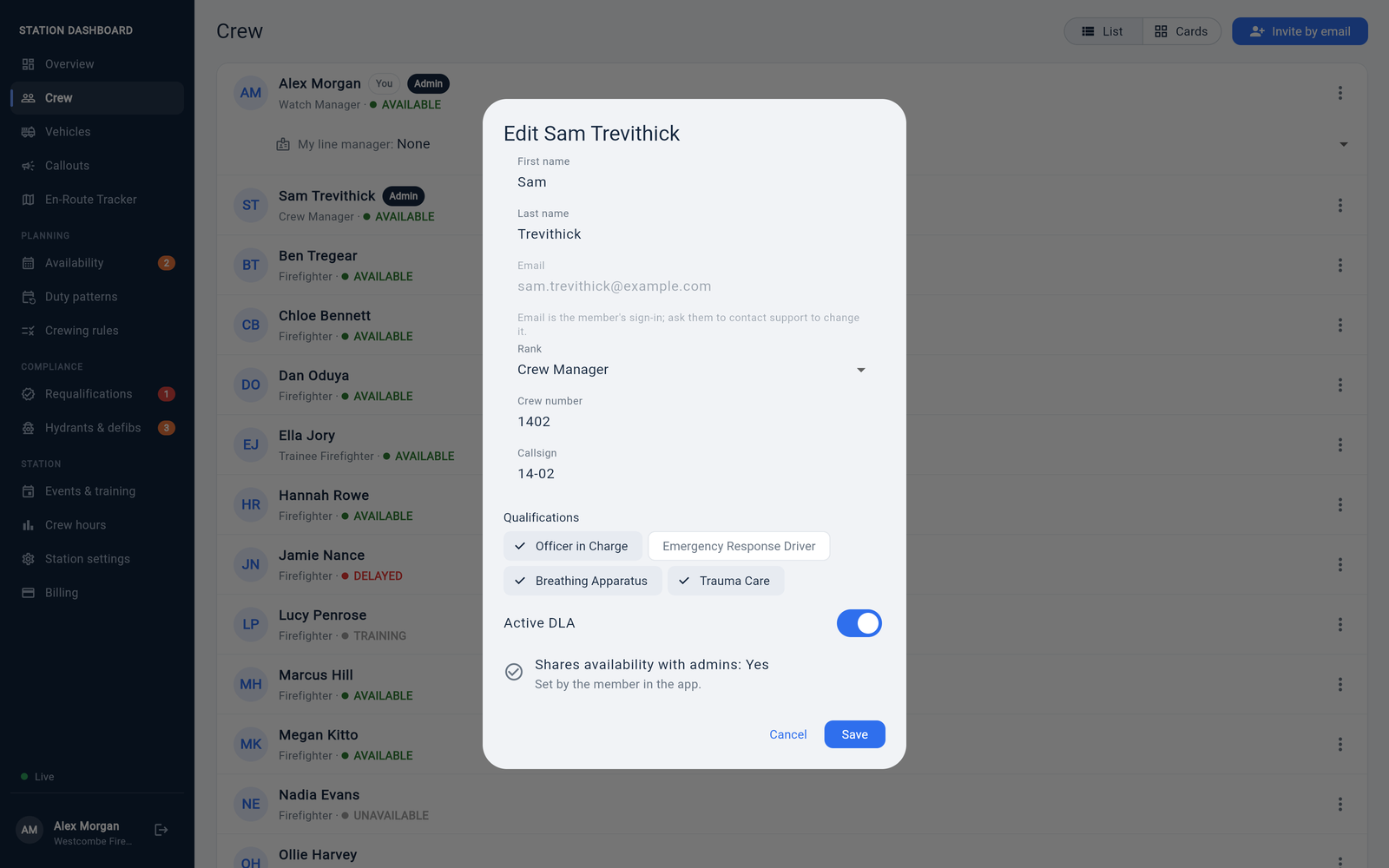
Crew profiles, ranks, qualifications and line managers. Contracted hours against the hours people actually give. Vehicles, events and training nights. New crew are invited by email, and they join automatically when they sign in to the app.
Everyone gets a login
- Crew members can see and update their own information.
- Line managers can also see and update availability for the crew they manage.
- Station admins run the whole station: profiles, ranks, qualifications, crewing rules, vehicles and billing.
There's no password to remember. You sign in with a one-time code sent to your email.
What it costs
Pricing is per station, and it depends on just one thing: how many active crew members you have.
- Monthly: £1 per active crew member per month, minimum £10 a month.
- Annual: £10 per active crew member per year, minimum £100 a year. That's two months free.
An active crew member is someone who has used the app or changed their own status in the last 60 days, or who joined the station in that time. Anyone else is free, so you never need to remove people who might still need a callout. Statuses set on someone's behalf, by an admin, a duty pattern or planned availability, don't make them active.
So a station with 14 active crew pays £14 a month, or £140 a year. A smaller station with six active crew pays the £10 minimum.
That price includes everything: the app for every crew member, the Station Dashboard, every feature, hosting, updates and support. There's no VAT to add, no setup fees and no add-ons. If new crew join part-way through, they're added from when they join. If your crew gets smaller, the lower price applies from your next renewal.
How it compares
Crew availability systems aren't new. The established ones are usually sold to whole services on enterprise contracts, with long procurement. In our experience they cost far more and do less for the people on the station floor.
We want iOnCall to compete with them head to head. A station subscription is what lets us do that: a price any station can justify from its own budget, and the development time to keep moving faster than they do.
The one thing that won't change: callouts
No crew should ever miss a shout because of a billing problem. So even if a subscription lapses, mobilisation alerts, responding, status updates, the station overview, the crew list and crew invitations all keep working.
What pauses until the subscription is renewed are the planning and compliance tools (availability planning, crewing rules, requalifications and duty patterns) and the premium app features.
Billing can lock the planning tools. It will never lock the pager.
What happens next
- Existing stations have until 31 January 2027, and everything keeps working as it does today. Station admins will get email reminders as the date gets closer, and can start a subscription from the Billing page of the Station Dashboard once it opens.
- New stations will be set up on the Station Dashboard and start a 30-day free trial straight away, with no card needed, once it opens. Get in touch if you'd like to hear the moment it does.
- Stations that already have a station subscription keep their current plan for now. We'll be in touch before anything changes.
- If you pay for a personal subscription through the App Store or Google Play, it keeps working for as long as it's active. We're no longer selling new ones. Once your station subscribes, everyone on the station is covered, so you can cancel yours in your store account settings.
Some stations won't come with us
I know not every station will subscribe. For some crews, the app is something they open now and then, and paying for it won't make sense. I'll be genuinely sorry to see them go, because every station that has used iOnCall has helped shape it.
But I'd rather build something stations value enough to pay for, and give it the time it deserves, than keep stretching a free service thinner.
If you have questions, or you'd like a hand getting your station set up, get in touch. And thank you: for using it, for the feedback, and for the ideas that have made it what it is.
Graham Murt
Retained firefighter and founder, iOnCall